





Small flow passages. Integrated filtration. A complete valve specification.
A custom miniature high-pressure valve needs more than a pressure rating. Its small flow passages, seat geometry, actuator and contamination protection must work together at the required flow, temperature and pressure differential. For equipment OEMs, specifying these relationships early helps avoid a valve that fits the installation but cannot meet the operating sequence.
MH develops and manufactures miniature hydraulic and pneumatic valves, drawing on established aviation valve applications. We also offer custom valves with integrated sintered filters, using sintered stainless steel wire mesh or sintered stainless steel fiber felt selected for the duty. Customers can supply complete drawings, or start with installation interfaces and performance requirements for complete-valve design, manufacturing and verification.

MH valve and cartridge examples with physical size references. Valve function, body size and internal passage dimensions are specified separately.
1. Define What the Miniature Valve Must Do
Begin with the circuit function: shut off, prevent reverse flow, relieve pressure, regulate pressure, restrict flow or switch ports. A miniature hydraulic valve used in an oil circuit has different fluid and operating requirements from a high-pressure gas valve. Include flow direction, backpressure and the required state when electrical power or control pressure is lost.
For a check valve, specify the opening differential and reverse leakage. For a relief valve, specify the opening criterion, pressure at the required relief flow and reseating behavior. For a miniature high pressure solenoid valve, specify energized and de-energized port states, supply voltage, duty cycle and switching conditions. A circuit sketch is a useful starting point, even before the internal valve design exists.
2. Specify Pressure Containment and Operating Differential
State inlet and outlet pressures together. An inlet at 20 MPa and an outlet at 18 MPa create a 2 MPa differential; the same inlet with an outlet at 1 MPa creates a 19 MPa differential. Use consistent pressure references. For gas-flow calculations, identify absolute pressure and the reference conditions used for reported flow.
A high pressure solenoid valve must contain the fluid pressure and switch at the specified differential. These are separate requirements. Include minimum available voltage, hot-coil conditions, pressure at each port during switching, and relevant reverse or trapped-pressure conditions.
Keep working pressure, proof-test pressure and burst qualification separate. Define the medium, temperature, pressure, hold time, port connections and acceptance criteria for each applicable test. A proof-test value is not an additional continuous working rating. Include post-test function and leakage checks where required.
3. Match Small Flow Passages to Measured Flow
In a miniature valve, a small metering passage may control flow while other sections provide connection or sealing functions. Specify passage diameter separately from body diameter and port size. Passage geometry, length, surface condition and fluid properties all influence the installed result; an orifice dimension alone is not a complete flow requirement.
Define required flow at stated inlet pressure, outlet pressure and fluid temperature. For liquids, identify the fluid and relevant viscosity. For gases, state whether the value is mass flow, actual volumetric flow or volumetric flow at named reference conditions. Include the permitted tolerance and flow direction.

Precision turning and machining support valve bodies, interfaces and controlled mating features. Flow and sealing performance are verified separately from dimensions.
4. Design the Valve with Its Sintered Filter
Small flow passages and close-clearance moving parts are sensitive to contamination. Particles can obstruct a restrictor, interfere with motion or become trapped at a seat and increase internal leakage. A valve with an integrated filter can provide local particle protection close to the sensitive flow path, including against debris introduced during installation or maintenance.
MH can incorporate a sintered stainless steel filter into a custom valve design. Sintered stainless steel wire mesh and sintered stainless steel fiber felt offer different filter structures; we match the medium, support, end fittings and sealing arrangement to the fluid, particle-control requirement and installation envelope. The selected filter must direct the intended flow through the medium without an unintended bypass around its mounting.

An MH metal filter-element example showing a filtering section and mounting interface. Custom integrated sintered filters are designed around the valve flow path and available space; this independent element is not an internal view of the valves shown above.
Include filtration in the pressure-drop budget. Specify the permitted pressure loss across the complete valve-and-filter assembly at the required flow. Allocate that budget between the filtering element and valve passages, then assess how increasing filter restriction could affect flow, actuator operation or pressure sensing. The clean-filter condition alone does not define the service condition.
Separate system pressure from filter differential pressure. A high-pressure valve body and a filter layer face different loading conditions. Define the pressure difference across the filter in normal flow, reverse flow and foreseeable blockage conditions, with suitable support and agreed strength verification. Do not use the valve working-pressure rating as the filter collapse rating.
Define filtration performance and maintenance. State the particle-retention target and verification method, rather than relying only on a nominal micron label. Include expected contamination, service interval and whether the element is accessible or replaced with the valve. Integrated local filtration complements system cleanliness and upstream filtration; it does not eliminate those requirements.
For related component options, explore MH custom metal filter elements. The valve and filter can then be specified as a matched assembly rather than two unrelated catalog selections.
5. Define Leakage, Temperature and Installation Together
Distinguish leakage through the closed flow path from external leakage. Give the test medium, direction, pressures, temperature and allowable limit. For relief functions, define the opening and reseating criteria separately from the pressure at which the specified discharge flow is available. Identify downstream pressure conditions and the intended pressure-sensing reference.
Name the actual fluid and its relevant composition, not just "gas" or "oil." Give fluid and ambient temperatures, operating cycles, dwell periods and electrical energization patterns. Temperature and fluid compatibility affect seals, clearances and the integrated filter assembly as well as the valve body.
Provide the maximum installation envelope, port and sealing details, retention method and assembly access. Allow space for wiring and filter service where applicable. A custom miniature valve can be designed around the equipment interface; customers do not need to produce internal component drawings before starting a design discussion.

Dimensional inspection supports agreed interface and component geometry. Small-passage flow and closed-valve leakage require their own functional acceptance tests.
6. Agree How the Complete Assembly Will Be Verified
For a valve with an integrated sintered filter, the acceptance plan should cover the assembled product, not only the separate filter and valve parts. Define pressure integrity, internal and external leakage, actuation and flow at the agreed test points. Where required, add filter integrity or retention checks, differential-pressure strength, temperature exposure and endurance with suitable acceptance criteria.
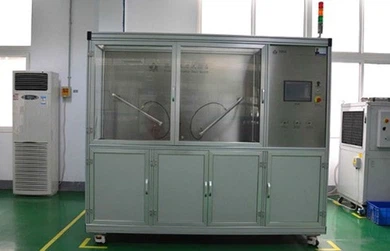
Flow and flow-resistance testing supports evaluation of valve and filter pressure losses at specified fluid conditions.

Pressure and sealing test equipment supports project-defined acceptance. Test medium, pressure, duration and leakage limits form part of the specification.
MH combines engineering, precision manufacturing, assembly and agreed functional verification, supported by ISO 9001 and AS9100 quality systems. Our aviation valve experience and sintered filtration capability support coordinated development of the flow path, sealing features and local contamination protection.

Workshop organization and material segregation support controlled handling through manufacturing and assembly. Cleaning and final cleanliness requirements are defined for the project.
A Practical RFQ for a Custom Miniature High-Pressure Valve
| Function and sequence | Valve function, port states, flow direction, backpressure and safe-state requirements. |
| Pressure and flow | Inlet/outlet pressures, maximum operating differential, transients and flow with fluid/test conditions. |
| Small flow passages | Critical metering requirements, installation space and any passage or interface constraints. |
| Integrated sintered filter | Particle-control target, allowable pressure drop, filter differential-pressure duty and service access. |
| Fluid, temperature and drive | Fluid identity, fluid/ambient temperatures, supply voltage and energization pattern where applicable. |
| Acceptance and supply | Leakage limits, endurance target, qualification scope, documentation, prototype quantity and repeat demand. |
A complete specification is not required for the first conversation. Send an interface drawing, circuit sketch or a brief description of the pressure, fluid, flow and space available. Tell us if local protection of a micro-orifice or valve seat is a priority, so that filtration can be included from the start.
Questions About Miniature Valves and Integrated Filters
Can MH design the complete valve without internal part drawings?
Yes. We can start from installation interfaces and operating requirements, develop the internal valve and filter arrangement, and manufacture and verify the assembly against the agreed specification. Build-to-print manufacturing is also available.
Does every miniature valve need an integrated sintered filter?
The decision depends on passage sensitivity, system cleanliness, contamination sources, pressure-drop allowance and maintenance strategy. Integrated filtration is a custom option, not a universal configuration for every MH valve.
Is the finest filter always the best choice?
The particle-control target must be balanced with filtering area, flow resistance, contamination loading and available space. Select the filter together with the valve duty and verify the assembled flow path.
Browse MH hydraulic and pneumatic valves or our solenoid valve range to discuss the appropriate function. For an interface-led development project, send your miniature valve and filtration requirements to MH.